Sofia retrieval benchmark after PR #9
Date: 2026-11-04. Source: a benchmark summary supplied by the user from Sofia's environment. Values below are transcribed from the original screenshot. This is deployment evidence for ADR 0010, separate from its local synthetic measurements. The raw requests, per-query samples, resource logs and scripts were not supplied; no new benchmark was run for this report.
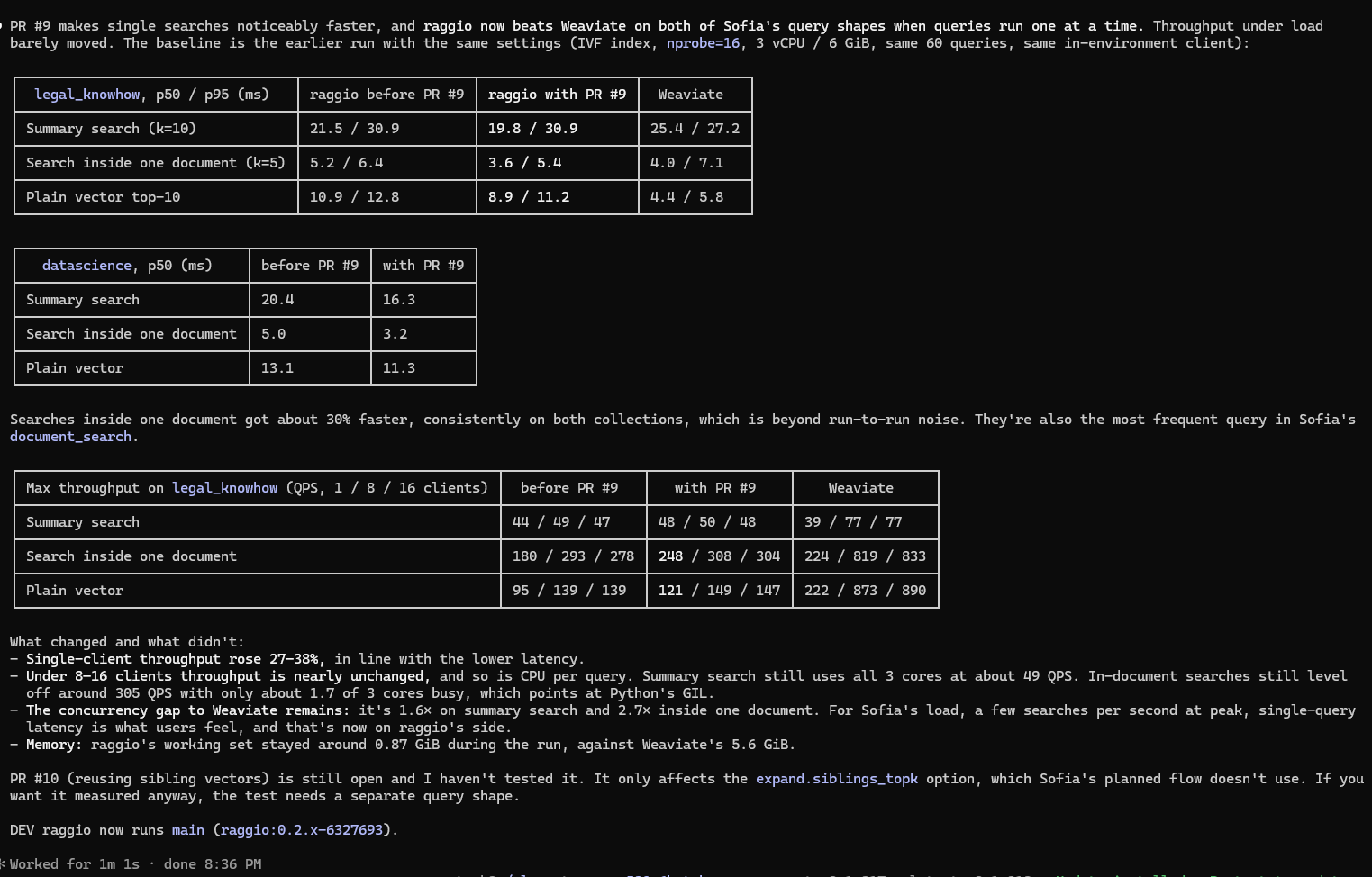
This is historical evidence for the PR #9 revision. The subsequent PR #11 evaluation and accepted baseline records the scoped-search optimization and replaces PR #9 as the comparison baseline.
Reported setup
- Same settings in the earlier baseline and PR #9 run: IVF index,
nprobe=16, 3 vCPU / 6 GiB, the same 60 queries, and the same in-environment client. - Collections:
legal_knowhowanddatascience. - DEV raggio was reported running main, image label
raggio:0.2.x-6327693. - PR #9 is merged at
6327693. PR #10 was not tested in this deployment run. - Sofia's planned flow uses summary search and search within one document;
in-document search is reported as the most frequent query in
document_search. The planned flow does not useexpand.siblings_topk.
Single-query latency
Times are milliseconds. Improvement is (before - after) / before, calculated
from the displayed rounded p50 values.
legal_knowhow query |
Before PR #9 p50 / p95 | With PR #9 p50 / p95 | p50 improvement | Weaviate p50 / p95 |
|---|---|---|---|---|
| Summary search, k=10 | 21.5 / 30.9 | 19.8 / 30.9 | 7.9% | 25.4 / 27.2 |
| Search within one document, k=5 | 5.2 / 6.4 | 3.6 / 5.4 | 30.8% | 4.0 / 7.1 |
| Plain vector top-10 | 10.9 / 12.8 | 8.9 / 11.2 | 18.3% | 4.4 / 5.8 |
datascience query |
Before PR #9 p50 | With PR #9 p50 | p50 improvement |
|---|---|---|---|
| Summary search | 20.4 | 16.3 | 20.1% |
| Search within one document | 5.0 | 3.2 | 36.0% |
| Plain vector | 13.1 | 11.3 | 13.7% |
The strongest measured benefit is in-document latency, improving on both collections.
On legal_knowhow, raggio has lower p50 than Weaviate for both planned Sofia query
shapes. The summary p95 is unchanged and remains higher than Weaviate's; plain vector
top-10 remains slower than Weaviate. Do not describe every latency metric as a win.
Throughput under load
Maximum reported QPS on legal_knowhow. Each cell lists 1 / 8 / 16 clients.
| Query | Before PR #9 | With PR #9 | Weaviate |
|---|---|---|---|
| Summary search | 44 / 49 / 47 | 48 / 50 / 48 | 39 / 77 / 77 |
| Search within one document | 180 / 293 / 278 | 248 / 308 / 304 | 224 / 819 / 833 |
| Plain vector | 95 / 139 / 139 | 121 / 149 / 147 | 222 / 873 / 890 |
Single-client QPS rises 37.8% for in-document search, 27.4% for plain vector and 9.1% for summary search. At eight clients, gains are 5.1%, 7.2% and 2.0% respectively; at sixteen, 9.4%, 5.8% and 2.1%. Latency gains do not establish a similar improvement in throughput under load.
The report says CPU per query is nearly unchanged under 8–16 clients. Summary search uses all three cores near 49 QPS; in-document search levels off around 305 QPS with about 1.7 cores busy. The latter is consistent with serialization or GIL contention, but utilization alone does not identify the limiting stage. At sixteen clients, Weaviate reaches about 1.6 times raggio's summary QPS and 2.7 times its in-document QPS. These are throughput ratios for this run, not latency ratios or a forecast for other CPU limits.
Memory and workload value
Reported raggio working set stays around 0.87 GiB, compared with Weaviate's 5.6 GiB: about 84.5% lower, or 6.4 times smaller. This is an observed working set, not a maximum-memory guarantee or a new memory saving caused by PR #9.
Sofia is reported to need only a few searches per second at peak, so latency on its actual query shapes has more immediate value than maximum-QPS parity. PR #9 therefore provides useful deployment evidence for the focused Python/native architecture. This run does not evaluate a Rust rewrite or isolate language costs.
Implications for the next investigation
PR #10's bounded sibling-vector reuse applies to ranked vector expansion through
expand.siblings_topk. It cannot improve the planned Sofia requests described here.
Keep its optional feature evaluation separate; do not attribute these results to it
or require an expanded-sibling benchmark to assess Sofia's normal flow.
Prioritize the existing scoped-search path and result materialization:
- Profile summary scope and in-document filters at 1 / 8 / 16 clients on the same corpus. Separate request parsing/normalization, allowlist construction/cache misses, masked index search, fp16 fetch/rescoring, hydration/metadata decoding, response encoding, event-loop delay and worker-queue time. Record p50/p95, CPU/query and working set alongside QPS.
- In the current implementation,
_vector_idsroutes summary-scoped searches when chunk rows exist, and document-filtered searches, through a per-request allowlist path. They bypass_scan_batched, which coalesces unrestricted full-index queries. Evaluate batching compatible large scoped allowlists only if profiling shows repeated scans/rescoring dominate; preserve snapshot, cancellation, score/order and low-load latency behavior. Small in-document allowlists already use direct exact scoring and may need a different improvement. _hydrateperforms record reads and metadata decoding synchronously inCollection.search. Measure its event-loop contribution before choosing off-loop materialization or native work; moving work to threads does not itself remove the GIL or guarantee less CPU.
ADR 0006 already records mixed free-threaded tradeoffs, including memory and single-query latency costs. Its experimental image can help isolate interpreter contention after profiling, but the utilization figures here do not justify making it the default or overriding its decision gates.
Use the same query requests, corpus/index snapshot, software versions, CPU/memory limits and BLAS settings in alternating baseline/candidate runs. Check response IDs, scores and order, and retain raw rounds. Improvements for Sofia should include its frequent low-concurrency requests, not just saturated synthetic expansion.