Sofia retrieval baseline after PR #11
Recorded: 2026-11-05. The user supplied this Sofia benchmark summary and accepted PR #11 as the new baseline. The tables below are transcribed from the source screenshot. No benchmark was rerun for this document; raw requests, per-query samples, repeated rounds, resource logs and benchmark scripts were not supplied.
Baseline identity
- Previous baseline: main
632769359c783435cdfdf3ed916110560ab5608b, including PR #9. - Tested implementation:
1cdae1df2196634b914662b470e4fa7d3c0e2fc5, PR #11's bounded warm scope-search batching, documented in ADR 0013. - Accepted code baseline: main after merge
01b160ff62a7d03573e2f5f9536399b8861b7814. The report and decision updates add documentation without changing that runtime. - PR #10 was closed without merging on 2026-11-05; its optional ranked sibling-vector reuse is excluded from this baseline. ADR 0012 retains the evaluation and closure rationale.
- Store source SHA-256:
2e5d9647907df908f4dec19c4ab48a0d682ec9eb73392a2ae4a5f18c35fc631d. - The same implementation passed all five PR CI jobs: production/reference, native x86_64/ARM64, and experimental free-threaded x86_64/ARM64 including their extended concurrency stress runs. The production interpreter decision is unchanged.
Reported deployment setup
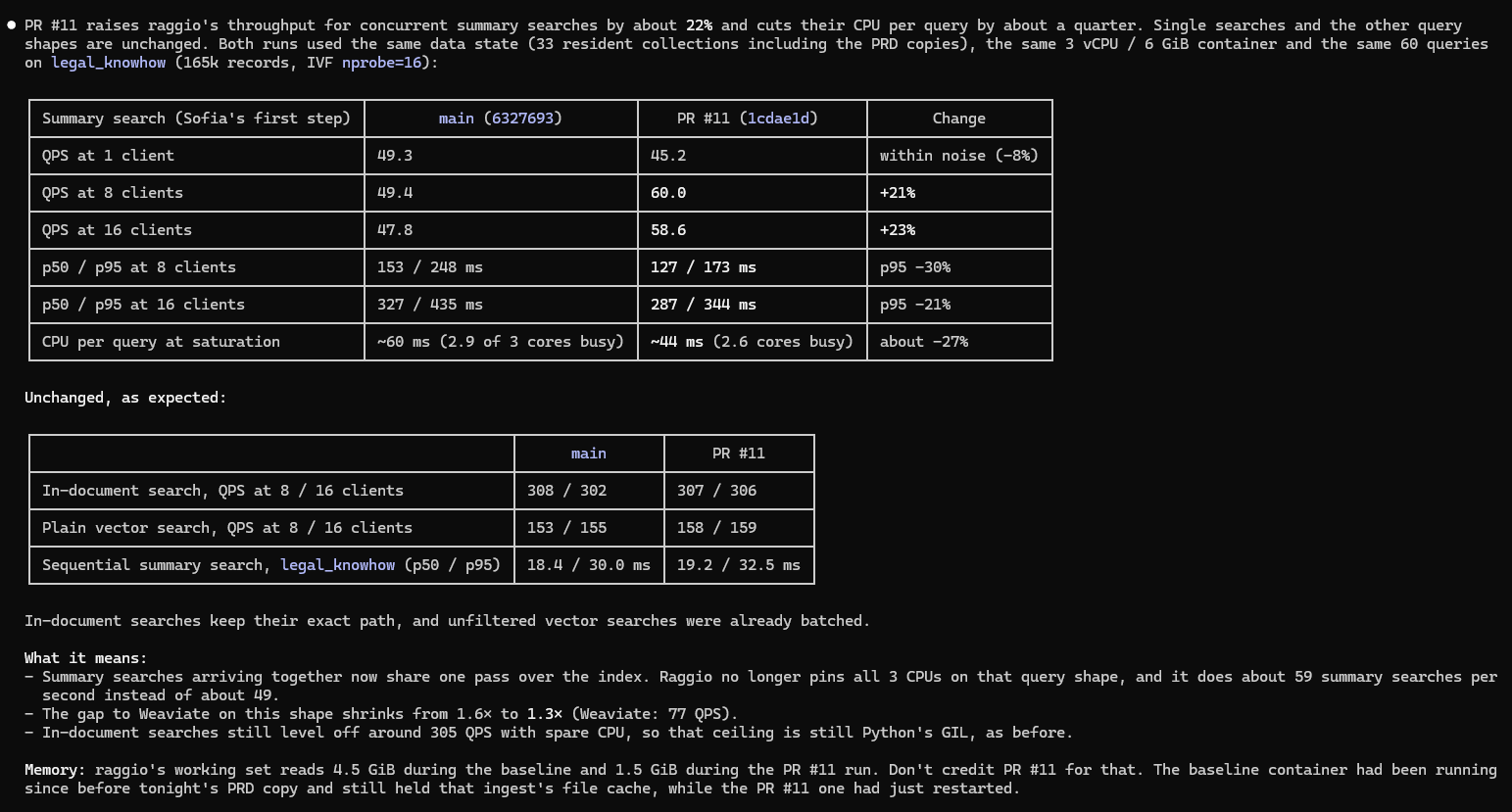
Both runs used the same data state, with 33 resident collections including PRD
copies, a 3 vCPU / 6 GiB container, and the same 60 queries on legal_knowhow
(about 165,000 records, IVF, nprobe=16). Summary search is Sofia's first step.
No ranked sibling expansion is reported for this workload.
Summary search results
Percent changes are calculated from the displayed rounded values. CPU values are approximate. These deployment measurements are separate from ADR 0013's generated local fixture and must not be combined with its paired ratios.
| Metric | Main 6327693 |
PR #11 1cdae1d |
Change |
|---|---|---|---|
| QPS, 1 client | 49.3 | 45.2 | -8.3% |
| QPS, 8 clients | 49.4 | 60.0 | +21.5% |
| QPS, 16 clients | 47.8 | 58.6 | +22.6% |
| p50 / p95, 8 clients | 153 / 248 ms | 127 / 173 ms | p50 -17.0%, p95 -30.2% |
| p50 / p95, 16 clients | 327 / 435 ms | 287 / 344 ms | p50 -12.2%, p95 -20.9% |
| CPU per query at saturation | approximately 60 ms | approximately 44 ms | approximately -26.7% |
| Busy cores at saturation | approximately 2.9 of 3 | approximately 2.6 of 3 | Less CPU pressure |
The report describes the single-client QPS difference as within noise. Without raw repeated runs this document cannot establish that statistically; retain the observed decline and claim no single-query speed improvement. Concurrent summary capacity improves by about 22%, with less CPU per query and better tail latency. This is smaller than the local synthetic gain and is the relevant deployment evidence.
Control query shapes
| Metric | Main 6327693 |
PR #11 1cdae1d |
|---|---|---|
| In-document QPS, 8 / 16 clients | 308 / 302 | 307 / 306 |
| Plain vector QPS, 8 / 16 clients | 153 / 155 | 158 / 159 |
| Sequential summary p50 / p95 | 18.4 / 30.0 ms | 19.2 / 32.5 ms |
In-document searches retain their exact small-set path; unrestricted vector searches were already batched. Their throughput changes are small, and the sequential summary sample is slightly slower. PR #11 improves concurrent summary capacity rather than the frequent low-concurrency document-search latency.
The report cites Weaviate at 77 summary QPS, narrowing its throughput ratio over raggio from about 1.6 to 1.3. This is a reported comparator, not a new independent Weaviate measurement. In-document searches still plateau near 305 QPS at similar CPU use. Serialization/GIL contention remains a hypothesis; utilization alone does not identify the limiting stage or justify a different interpreter.
Memory interpretation
Reported working set was 4.5 GiB in the baseline run and 1.5 GiB in the PR #11 run. The baseline container had remained running after overnight PRD copies and still held ingestion file cache; the candidate container had just restarted. Do not attribute this difference to PR #11 or treat it as a controlled memory comparison.
ADR 0013's separate local eight-query diagnostic found about 2.45 MB more temporary allocation with batching. Its 16 MiB per-cohort float32 payload budget is not an overall RSS cap. The deployment working-set sample does not supersede that documented CPU/temporary-memory tradeoff.
Use for future comparisons
Use the PR #11 runtime on main as the comparison baseline for further retrieval work. Keep the November 4 PR #9 report and ADR 0013's local raw experiments as historical evidence, with their original revision and environment labels.
Future benchmarks should fix the corpus/index state, query requests, interpreter, CPU/memory limits and BLAS settings; give both arms equivalent restart/cache warmup history, alternate repeated rounds, check result IDs/scores/order, and retain raw samples. Report single-query and concurrent latency, QPS, CPU/query and controlled memory separately. Ingestion remains outside the optimization scope.